An Bradán Feasa: From an Anglo-Norman Lord to Lady Gregory
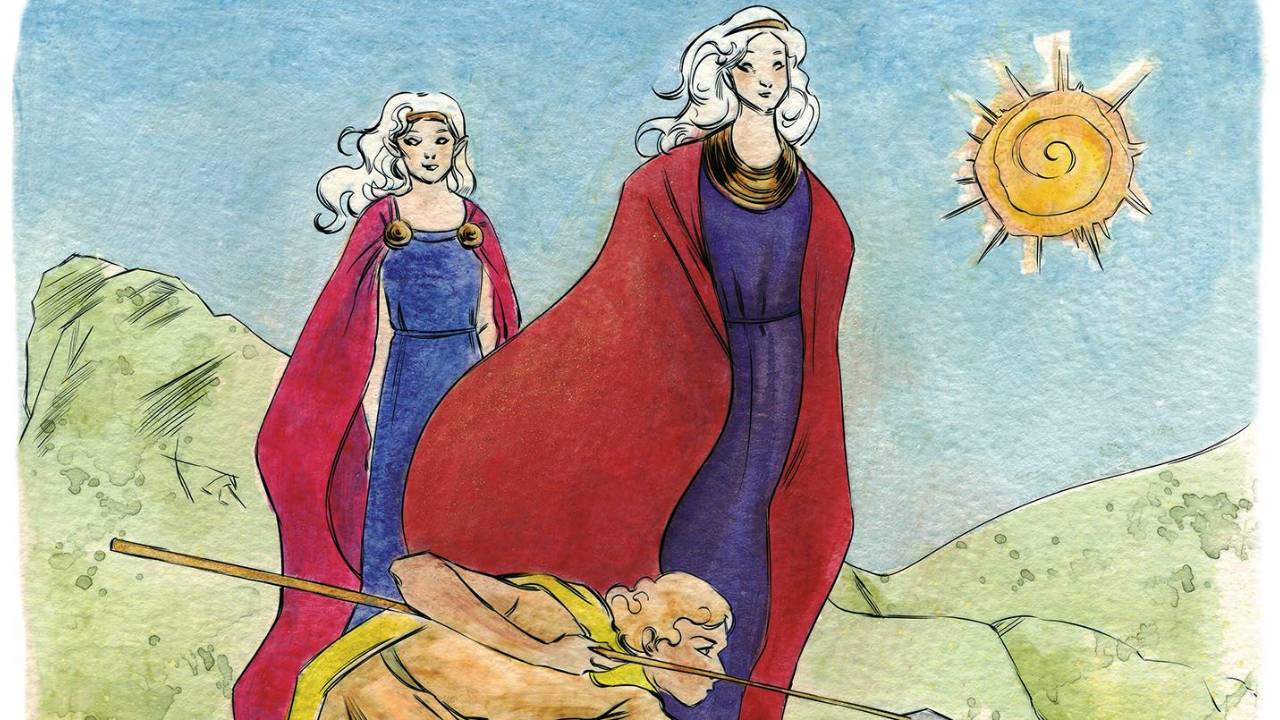
A young boy is sent to learn poetry from an old poet on the banks of abhainn na Bóinne / the river Boyne. The poet has spent seven years trying to catch a salmon that will give all the knowledge in the world to whoever eats it. When the salmon is finally caught the boy cooks it, but is warned not to taste it. The boy burns his ordóg / thumb on the hot skin, sucks it to ease the pain, and the fios / knowledge passes to him instead.
Most of us know the story of Fionn and the Salmon of Knowledge (Fionn agus an Bradán Feasa) from a version shaped over a century ago by Lady Gregory. Her version differs quite a bit, however, from the earliest written version, contained in a 15th century manuscript called the Laud Manuscript.
How much of the story that we know today is due to Lady Gregory and the Irish Literary Revival of the early 1900s, and how much of the tale that we are so familiar with can be traced back to the 15th-century Irish manuscript in the possession of the Bodleian Library in Oxford?
The Laud Manuscript
The oldest surviving version of the story is contained in Macgnímartha Finn ("The Boyhood Deeds of Finn"), a text preserved in only one manuscript: Laud Misc. 610, held in the Bodleian Library, Oxford.
The manuscript was written in Ireland around 1450 for Edmund Butler of the Butlers of Ormond. The Butlers were descended from Theobald Walter, an Anglo-Norman knight who came to Ireland in 1185. By the 15th century, families like theirs had become patrons of Irish learning, commissioning scribes to copy older Irish texts.
Macgnímartha Finn itself is much older than the manuscript. Scholars date its language to around the 12th century. The only surviving copy is also incomplete: it breaks off in the middle of a later episode.
The manuscript gets its name from Archbishop William Laud, who gave it to the Bodleian in the 1630s along with many other manuscripts from his collection.
You can see the manuscript itself online:
Unless you can understand Middle Irish you might have a hard time making out the story from the link above however!
Ach ná bí buartha! No worries! German scholar, Kuno Meyer, published an English translation in the journal Ériu in 1904. An earlier, partial translation by John O'Donovan had appeared in 1859. (The story of the Salmon of Knowledge is at the bottom of page 185 of Meyer's translation. Scroll to the bottom of the link below, and you will find the page numbers close to the right hand margin).
The Story in the Old Text
In Macgnímartha Finn, the hero is not called Fionn at the start. His name is Deimne. He is the son of Cumhall, leader of the Fianna, who was killed by Goll mac Morna. The boy is raised in secret in the woods by two women, to keep him safe from his father's enemies.
As he grows, people notice how fair he is, and he is given the name Fionn, meaning "fair" or "bright". Even so, when he goes to learn poetry beside the Boyne, he again calls himself Deimne, keeping his identity hidden.
His teacher is a poet called Finnéces (modern Irish Finnéigeas). His name means roughly "Finn the Poet" or "Finn the Seer", from éces, a learned poet. He has spent seven years watching the salmon of Linn Féic, a pool on the Boyne, because it was prophesied that Finn would eat it and gain all knowledge.
That is where the story turns. Finnéces assumes the prophecy is about him, because he is a Finn too. When the boy brings back the cooked fish and admits he burned his thumb and put it in his mouth, the poet asks his name. The boy says Deimne. Finnéces replies that his name is really Finn, and that the salmon was meant for him all along. He gives the boy the whole fish.
Afterwards, Fionn learns the three arts of a poet, which the text names: teinm laída (revealing hidden knowledge through chanting), imbas forosnai (prophetic vision) and díchetal di chennaib (composing verse on the spot).To show his new skill, he composes a poem in praise of May Day. Whenever he later puts his thumb in his mouth, hidden knowledge is revealed to him.
Lady Gregory and Gods and Fighting Men
Lady Augusta Gregory (1852–1932) was an Anglo-Irish writer, folklorist and dramatist, and a leading figure in the Irish Literary Revival. She co-founded the Abbey Theatre with W. B. Yeats and wrote many plays for it. She collected folklore from people living around her home at Coole Park, Co. Galway.
In 1904 she published Gods and Fighting Men, a retelling of the stories of the Tuatha Dé Danann and the Fianna, with a preface by Yeats. It followed her earlier Cuchulain of Muirthemne (1902), which covered the Ulster Cycle. The salmon story appears in the chapter "The Coming of Finn".
She did not translate directly from manuscripts. Instead, she worked from the translations of scholars such as John O'Donovan and Kuno Meyer, comparing different versions of each tale and weaving them into one continuous narrative.
She wrote in what she called "Kiltartan" English, a style based on the Hiberno-English speech of people near Coole. Its rhythms and turns of phrase give the stories the feel of a tale told aloud by the fireside. The books were hugely popular and introduced the old Irish stories to a wide audience.
- Gods and Fighting Men on Project Gutenberg
- "The Coming of Finn", the chapter with the salmon story (sacred-texts.com)
What Lady Gregory Changed
The heart of the salmon episode is faithful to the old text: the seven-year wait, the warning not to taste the fish, the burned thumb, the name Deimne and the poet's realisation. But she reshaped the story around it in several ways.
- The name twist is lost. In her version, the prophecy says simply that the poet would eat the salmon. English readers miss the point of the original, where the prophecy names "Finn" and the poet, being a Finn himself, takes it to mean him.
- The hazelnuts of wisdom are added. She says the knowledge came from the nuts of nine hazels that grow beside a well. The hazels are not in the Laud text. They come from other Irish traditions about sacred wells and the source of wisdom, which she brought into this story.
- Two poems become one. After Fionn's May Day poem, she continues with verses about winter, the cold wind and the end of summer. These come from a separate Old Irish poem, Scél lem dúib ("I have news for you").
- The violence is softened. In her version, Fionn earns his name by beating some boys at swimming. In the old text, the naming happens over a hurling match, and at the lake he drowns nine of the boys.
This was her deliberate method. She smoothed away much of the violence and coarseness of the originals and drew material from many sources into a single, readable whole. Her versions are best read as a literary retelling rather than a faithful record of the medieval texts.
Which is the real version?
The story we know today has been transmitted for centuries. A 12th-century tale (and possibly earlier), copied by a 15th-century scribe for an Anglo-Norman lord, rediscovered by 19th-century scholars and then retold for a new generation by Lady Gregory. Just like Chinese whispers each retelling changes the story a little.
Reading the two versions side by side is an interesting exercise. Lady Gregory's version is gentler and more accessible. The older text is stranger, harsher, and in some ways cleverer, with its wordplay on the name Finn. Is fiú an péire acu a léamh! Both are worth reading.
Improve your Irish with Listen Up Irish!
Sign up to a course or a challenge with Listen Up Irish and improve your Irish effortlessly.
The Listen Up Irish method is a relaxing and enjoyable way to learn Irish; but most of all it's a way to connect with the best authentic Irish language literature in a way that is accessible and fun.
Choose either a course (get started right away) or a challenge (learn with others at the same time), whichever works best for you!